
The Rohingya: A Forgotten People and the Case for Education as Liberation
A century of persecution, the world's largest stateless crisis — and why knowledge is the only durable answer.
1. Who Are the Rohingya?
The Rohingya are a Muslim ethnic group who have lived for centuries in the Arakan region — today called Rakhine State — on the western coast of what is now Myanmar. Their presence in the region predates modern borders: historical records place Muslim traders, scholars, and settlers on the Arakan coast as far back as the 8th century. The Kingdom of Mrauk-U, which flourished from the 15th to the 18th century, was home to a cosmopolitan population that included Muslim communities deeply woven into the social and economic fabric of the region.
The Rohingya speak their own language, practice their own traditions, and constitute one of the oldest continuous communities in Southeast Asia. For generations, they were recognized as a people with roots — not strangers, not infiltrators, but a community with a documented history older than the nation-state that would eventually deny their existence.

The Arakan Kingdom and Pre-Colonial Roots
Under the Mrauk-U dynasty, Muslim courtiers held positions of power, and Persian was used in royal correspondence alongside Burmese. This was not merely tolerance — it was integration. The Rohingya were not guests in Arakan; they were participants in its civilization. This long history matters enormously, because the central argument used to deny them citizenship — that they are Bengali immigrants who arrived during the British colonial period — is contradicted by centuries of documented habitation.
Colonial Disruption and Its Aftermath
The British annexation of Arakan in 1826, following the First Anglo-Burmese War, introduced new dynamics. Colonial administrators drew workers from British-controlled Bengal into the region, which did bring migration. But conflating those colonial-era migrants with the Rohingya — a community already rooted in Arakan for centuries — became the cornerstone of a deliberate strategy of erasure that would intensify dramatically after independence.
2. Systematic Erasure: How a People Were Made Stateless
Burma (renamed Myanmar in 1989) gained independence from Britain in 1948. Within a decade, the Rohingya began to experience the first systematic pressures of a state that would not recognize them. The process of erasure was gradual, then total.
"To be Rohingya in Myanmar is to exist in a legal void — denied citizenship, denied movement, denied education, denied the right to be born or married without state permission."
— Human Rights Watch, Documentation of Rohingya persecution
The 1982 Citizenship Law: The Legal Foundation of Statelessness
The pivotal moment came in 1982 when the military government enacted a new Citizenship Law that recognized 135 "national races" — and excluded the Rohingya entirely. Under this law, full citizenship required membership in one of those recognized groups or proof of residence prior to 1823. The Rohingya, despite centuries of documented presence, were reclassified as illegal immigrants from Bangladesh. Overnight, a population of hundreds of thousands became legally non-existent in the country of their birth.
The consequences were immediate and cascading. Without citizenship, Rohingya could not access government hospitals, could not send their children to state schools, could not hold government employment, could not freely travel between townships, and eventually could not register births or marriages without explicit government permission. Every dimension of civic life was closed off.
Decades of Violence
Statelessness created the conditions for escalating violence. Major pogroms erupted in 1978, 1991–1992, and 2012, each producing waves of refugees into Bangladesh. In 2016 and 2017, the violence reached a scale that the United Nations described in the strongest terms available: genocide.
3. The Current Crisis: Life in the Camps
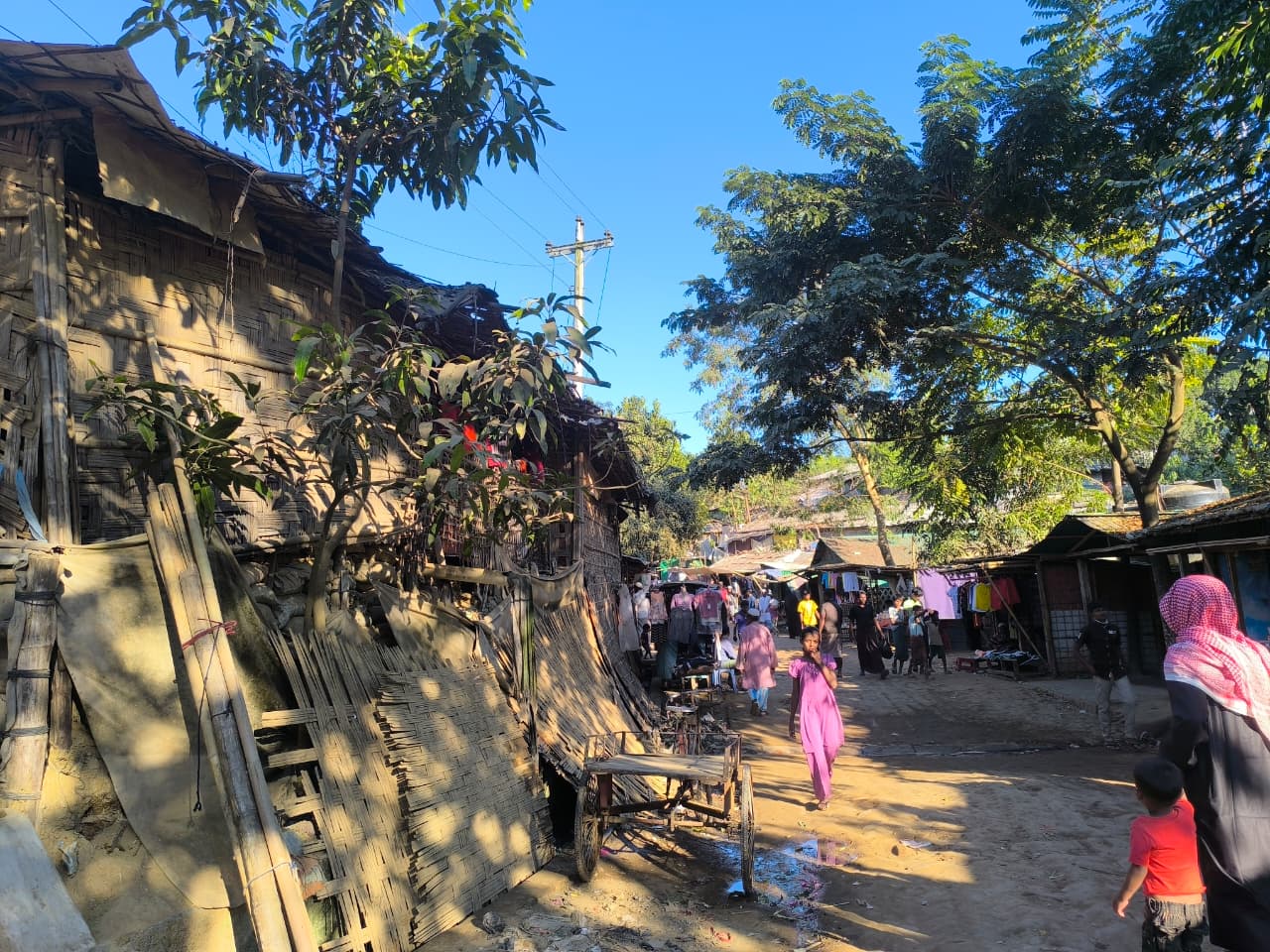
The majority of Rohingya refugees today live in Cox's Bazar, Bangladesh — home to what has become the world's largest refugee settlement. Kutupalong camp alone shelters over 600,000 people. But calling it a "camp" understates the reality: it is a city built from bamboo and plastic sheeting, without a functioning economy, without legal status for its inhabitants, without a path forward.

The Humanitarian Trap
International aid keeps the camps alive. Food, medicine, shelter — these are provided through a network of NGOs and UN agencies. But aid, by design, maintains survival rather than building futures. Refugees in Cox's Bazar are legally prohibited from working in the formal Bangladeshi economy. Movement beyond the camp perimeters is restricted. And crucially, Rohingya children — an estimated 400,000 of them — have had no access to Myanmar's formal educational system for a generation. In Bangladesh, they cannot enter the national school system. Many have known nothing but the camp.
A Generation Growing Up Without a Future
This is the deepest wound: the children. Born in camps, carrying no citizenship, unable to work legally, unable to study formally, unable to imagine a life with structure or opportunity — they are what aid workers and scholars call "a lost generation." But this phrase, however compassionate in intent, obscures a dangerous reality. Young people who have no stake in society, no skills, no legal identity, and no hope are extraordinarily vulnerable to recruitment by extremist networks. The Rohingya crisis is not merely a humanitarian emergency — it is a regional security issue whose pressure points will intensify as this generation reaches adulthood.
"When you deprive an entire generation of education, you do not just harm those children — you create a vacuum that violence is always ready to fill."
— UNHCR Strategic Analysis, Protracted Displacement
Regional Ripple Effects
The crisis does not stop at Cox's Bazar. Rohingya refugees have fled to Malaysia, Indonesia, Thailand, India, and Saudi Arabia — often through deadly sea journeys facilitated by human traffickers. The instability in Rakhine State itself has been exploited by armed groups including the Arakan Army, intensifying conflict in Myanmar's western region. Neighboring states face pressure on their borders, their coastlines, and their own domestic politics. What began as an internal persecution has become a regional destabilizing force, and no amount of border enforcement will contain a crisis whose root causes remain unaddressed.
4. Why Aid Alone Has Failed
The international response to the Rohingya crisis has been generous by humanitarian standards — billions of dollars in food, medicine, and shelter have flowed into Cox's Bazar since 2017. And yet, eight years later, the situation has not improved. In many respects, it has deepened. Why?
Because aid addresses symptoms, not causes. Emergency food prevents starvation today. It does not prevent starvation next year — or the year after. Emergency shelter protects people from monsoons this season. It does not build the capacity to earn, to produce, to build. Aid, at its most effective, is a bridge. When the bridge is never connected to the other shore — to employment, to education, to legal status, to dignity — it becomes a holding pattern without a destination.
The Rohingya in Cox's Bazar have now lived in this holding pattern for approaching a decade. The camp has become, for most, the only world their children have ever known. The infrastructure of aid has paradoxically entrenched the crisis by making permanent what was always meant to be temporary. Without a transformation in approach — one that builds capacity rather than merely maintaining survival — the camps of Cox's Bazar risk becoming the permanent home of a stateless people for generations to come.
5. The Yasmine Foundation Approach: Industrial Sovereignty Through Education
The Yasmine Children's Foundation was founded on a single conviction: that the only durable exit from humanitarian dependency is autonomy. Not aid. Not charity. Autonomy — the capacity of a community to produce, to educate itself, to generate value, and to negotiate its own future from a position of competence rather than desperation.
For the Rohingya, the Foundation's initiative — detailed in the Yasmine Rohingya Initiative — is structured around a simple but radical idea: transform displaced populations into certified industrial and intellectual professionals. Not through short-term skills workshops, but through a comprehensive ecosystem of shelter, energy, water, and knowledge — a portable city of capabilities.
Why Education Is the Strategic Priority
Education is not merely a humanitarian value — it is the single most effective tool for disrupting the cycle of displacement, poverty, and radicalization. A child who completes secondary education is dramatically less likely to be recruited by armed groups, less likely to remain in poverty, more likely to participate constructively in civic life, and more likely to be accepted by a host or resettlement country. A community where adults hold recognized professional qualifications has economic leverage — the capacity to contribute to rather than burden the economies of the countries around them.
For the Rohingya specifically, the absence of formal education has been weaponized. Statelessness is maintained partly by ensuring that Rohingya youth accumulate no credentials, no professional identity, no economic standing. Education is therefore not supplementary to the fight for Rohingya rights — it is central to it. A Rohingya nurse, a Rohingya programmer, a Rohingya certified industrial technician exists in the world in a fundamentally different way than a Rohingya refugee. The credential is not just practical. It is existential.
Phase 1 — Stabilization & Immediate Dignity
- Deploy YASMINE "Flex-Unit" modular shelters — steel-framed, insulated, erected in 4 hours
- Atmospheric water harvesters and filtration systems for clean water access
- Emergency nutritional support in partnership with Mercy Without Limits (MWL)
- Units are re-foldable and transportable if communities relocate
Phase 2 — Energy, Water & Immediate Schooling
- 1.2 kW household solar arrays with battery storage for every family
- Industrial solar and wind grids powering YASMINE Industrial Hubs 24/7
- Advanced water and wastewater treatment infrastructure
- Schools opened immediately for ages 3–17, using external teachers while local staff are trained
Phase 3 — The YASMINE Academy & Knowledge City
- Teacher certification programme: residents become qualified educators
- 30 vocational training centres (welding, carpentry, construction, electrical, agriculture)
- Professional tracks in nursing, nutrition, programming, and technical maintenance (with INARA)
- 15,000 connected learning tablets distributed monthly
- Curriculum designed for portability — qualifications recognized beyond any single country
6. How Education Diminishes the Regional Impact of the Crisis
The strategic logic is clear: an educated, credentialed Rohingya population changes the geopolitical calculus of the crisis in several concrete ways.
Reducing Vulnerability to Extremist Recruitment
Young men without education, employment, or legal identity are the primary target of extremist recruiters — in every refugee context in the world. In Cox's Bazar, the growth of criminal networks and armed groups recruiting from within the camps is already documented. The most effective counter-radicalization programme ever devised is a school. Not a single workshop. A sustained, structured, credentialing educational system that offers young people an alternative identity: not a refugee, not a stateless person, but a professional.
Creating Economic Contributors Rather Than Economic Burdens
Host countries — Bangladesh above all — face enormous pressure from the economic cost of sheltering over a million people with no legal right to work. This pressure fuels political hostility to the refugees and creates cycles of crackdown. A Rohingya population with internationally recognized vocational credentials becomes, by contrast, an economic asset. Trades such as construction, electrical work, nursing, and agricultural technology are in high demand across Southeast Asia. The transformation of refugees into skilled professionals does not just benefit the Rohingya — it benefits the economies of Bangladesh, Malaysia, and the broader region.
Building the Negotiating Capacity for Return
Any eventual resolution of the Rohingya crisis — whether through return to Myanmar, integration in host countries, or resettlement elsewhere — will be shaped by what the Rohingya community can offer and demonstrate. A stateless people with no skills, no credentials, and no economic contribution have little leverage in negotiations with states. A community of certified professionals — nurses, engineers, teachers, technicians — has standing. Education is therefore not separate from the political resolution of the crisis. It is preparation for it.
Breaking the Cycle of Generational Poverty
The children growing up in the camps today will be adults within a decade. Without intervention, they will repeat the trajectory of their parents: stateless, unemployable, aid-dependent, vulnerable. With the YASMINE Academy model, this generation becomes the first in their families to hold credentials, to have professional identities, to be capable of building — not just surviving. That break in the cycle has consequences that extend far beyond the individuals affected. It restructures the community's relationship to the world.
"We do not build schools because it is kind. We build schools because a population that can read, that can calculate, that can build and heal and teach — can no longer be ignored. They have too much to offer."
— Yasmine Children's Foundation, Mission Statement
7. A Global Template
The Yasmine Rohingya Initiative is explicitly designed as a model — not just an intervention. The portable, modular approach to shelter, energy, water, and education is engineered to be replicated. If it works for the Rohingya, the same system can be deployed for the next crisis, and the one after that. The Foundation's "Zero-Dependency Model" is a direct challenge to the humanitarian aid architecture that has governed displacement crises for seventy years — an architecture that has, despite extraordinary effort and genuine compassion, failed to resolve the underlying condition of any major protracted refugee crisis.
The bet the Foundation is making is this: that the Rohingya crisis is solvable not by more aid, not by political negotiations alone, not by waiting for Myanmar to reform — but by building, within the crisis itself, the conditions for the Rohingya's own emergence. A people who can power their own homes, purify their own water, educate their own children, and credential their own professionals are a people who have begun to solve their own problem. The Foundation's role is to build that platform and then step back.
Conclusion: The Only Lasting Answer
The Rohingya have survived centuries of empire, colonialism, military dictatorship, and genocide. They have survived not because the world protected them — largely, it did not — but because communities with deep roots are extraordinarily resilient. What they have never had, in the modern era, is the opportunity to convert that resilience into recognized capacity: the credentials, the skills, the professional standing that would allow them to participate in the world on terms other than dependency.
The Yasmine Foundation's approach is not sentimental. It does not ask for sympathy for the Rohingya — though their history demands it. It asks for something more practical and more powerful: the recognition that an educated, skilled, credentialed Rohingya population is better for everyone. Better for Bangladesh. Better for the region. Better for global security. And, of course, infinitely better for the Rohingya themselves.
The question is not whether education can change the trajectory of this crisis. The evidence from every comparable context shows that it can. The question is only whether the international community has the strategic clarity — and the will — to fund it before another generation is lost.